New Review Highlights Broad Preclinical Anticancer Activity of Ivermectin and Mebendazole Across Dozens of Mechanisms and Cancer Types
A newly released comprehensive review posted on Zenodo examines the potential of two well-known antiparasitic drugs—ivermectin and mebendazole—as adjunctive treatments in cancer care. The paper, authored by Nicolas Hulscher, MPH, James A. Thorp, MD, Kelly Victory, MD, Peter Gillooly, MSc, Peter A. McCullough, MD, MPH, and Harvey Risch, MD, PhD, synthesizes mechanistic, laboratory, and available clinical data through October 2026.
Ivermectin (a Nobel Prize-winning compound for its antiparasitic effects) and mebendazole are both oral, generic drugs listed on the WHO Model List of Essential Medicines. They have decades of safety data from widespread human use against parasites. The review argues they also show multi-target activity against cancer cells in preclinical studies.
Key Findings from the Review
The authors report:
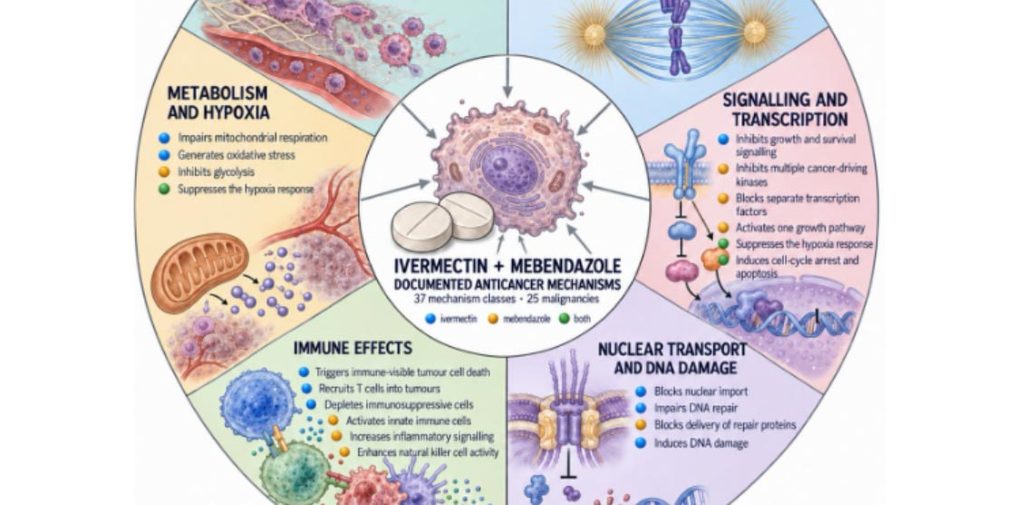
- 29 distinct anticancer mechanisms for ivermectin and 26 for mebendazole.
- When overlapping pathways are accounted for, this yields 37 distinct mechanism classes.
- Preclinical activity across 25 distinct human malignancies (ivermectin in 20 human cancers plus one canine model; mebendazole in 17 human cancers). These include common types such as breast, lung, colorectal, prostate, pancreatic, ovarian, brain (glioma/glioblastoma), and blood cancers, among others.
Mechanisms include effects on microtubules and mitotic arrest (especially mebendazole), disruption of signaling pathways (Wnt/β-catenin, Akt/mTOR, STAT3 and others for ivermectin), inhibition of angiogenesis, targeting of cancer stem-like cells, interference with multidrug resistance, effects on hypoxia signaling and DNA damage responses, and modulation of immune responses. The review notes the agents often act on complementary pathways, with limited overlap in transcription-factor targets and immune effects (ivermectin more adaptive, mebendazole more innate).
Cellular outcomes commonly described include cell-cycle arrest, mitochondrial apoptosis, autophagy (context-dependent), and immunogenic cell death. Lead author Nicolas Hulscher summarized the work on The Focal Points, calling it one of the broadest repertoires of anticancer mechanisms documented for an off-patent drug combination.
Clinical Evidence Cited
The review classifies six clinical studies with efficacy outcomes: three positive, two neutral, and one incomplete interim readout. Additional trials focused on safety or dosing.
A highlighted randomized, double-blind, placebo-controlled trial of mebendazole added to bevacizumab plus FOLFOX4 in metastatic colorectal cancer (40 patients) reported an overall response rate of 65% (13/20) versus 10% (2/20) in the control arm, and median progression-free survival of 9.25 months versus 3.00 months.
The authors also reference a prospective observational cohort of 197 cancer patients prescribed a compounded ivermectin-mebendazole combination (via a telemedicine platform), with 122 completing roughly six-month follow-up. That study reported an 84.4% “clinical benefit proportion” (no evidence of disease, regression, or stable disease) and 48.4% with no evidence of disease or regression. Side effects were described as mostly mild and gastrointestinal.
Important context: The observational study was published in Anticancer Research in June 2026 but was formally retracted in October 2026 (see the PubMed record and the journal’s retraction notice). The journal cited methodological and analytical problems that undermined the reliability of the central clinical-benefit conclusions, including issues with the composite outcome definition, self-reported survey data, lack of directly comparable baseline and follow-up measures, and absence of a control group. An earlier Expression of Concern had already flagged verifiability, statistical reliability, and ethical oversight issues. Authors disputed the grounds for retraction.
Neither drug is approved by regulatory agencies for the treatment of cancer. The review itself is posted on the open repository Zenodo rather than in a peer-reviewed journal. Authors have affiliations with the McCullough Foundation and The Wellness Company (which has offered compounded versions of the combination).
What This Means
Preclinical data for both agents as potential anticancer compounds is extensive and spans many pathways and cancer types, which is notable for inexpensive, off-patent drugs with established safety profiles in their approved indications. A small randomized trial provides a signal for mebendazole in combination with standard therapy in one cancer type. However, the most widely publicized human combination data come from a now-retracted observational report relying on patient-reported outcomes without a control arm.
The authors of the Zenodo review conclude that the mechanistic breadth supports the need for large, prospective, double-blind, randomized trials of the combination across malignancies. Independent experts and oncology standards emphasize that observational signals and preclinical activity require confirmation in rigorous controlled trials before clinical recommendations can be made. Self-medication outside approved uses carries risks and can interfere with proven therapies.
The full review, including a PDF of the manuscript, is available at the Zenodo record.
This article summarizes publicly available information from the Zenodo record and related reporting. It is not medical advice. Patients should consult qualified oncologists regarding evidence-based treatments.